
The Capella Project, Part 1.
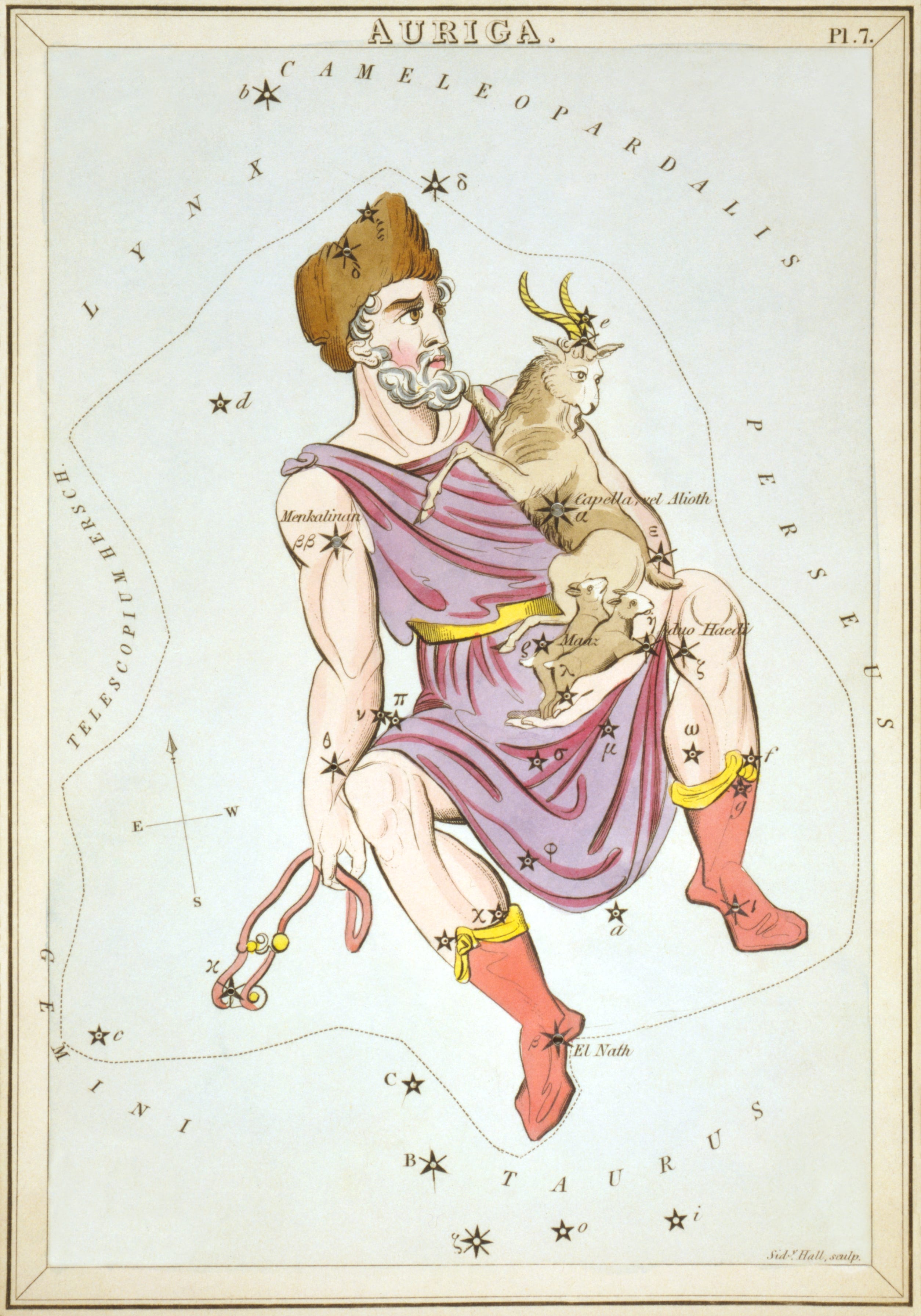
Caption: Auriga, plate 7 in Urania's Mirror, a set of celestial cards accompanied by A familiar treatise on astronomy ... by Jehoshaphat Aspin. London. Astronomical chart, 1 print on layered paper board : etching, hand-colored.
A quick bit of context, since this picks up in the middle of something. Earlier this year I taught a workshop called Finding Starry Patrons - about building working relationships with individual fixed stars rather than treating them as chart decoration. While putting the extra slides together I was fiddling around with the major fixed stars and noticed that Capella had an interesting, if imperfect, election coming up. One that also had a relationship with my natal Mercury worth considering.
In those extra slides I showed the election itself, with a quick rundown of what made it good and what made it problematic, and then spent about ten minutes online doing a first round of research on the star. I mentioned in the talk that at least a little reading is worth doing before First Contact with a star, and I wanted to show just how much can come out of only a couple of websites.
After the talk I decided that working through the whole process publicly - from this first research pass to a finished talismanic project culminating in mid-August - would be a good way to keep the conversation going and share how I actually work with stars, in case it’s useful to anyone else doing the same. So: this is where it starts.
If you’re new to this: An election is a deliberately chosen moment to do a piece of work, picked because the sky is favorable. A fixed star is one of the actual stars, as opposed to the “wandering stars”, aka planets. Capella is the brightest star in Auriga, the Charioteer - traditionally the goat he carries on his shoulder - and one of the fifteen Behenian stars, a medieval set singled out as especially useful for magical work, each with its own herb, stone, and engraved image.
The Election
This is the chart I walked through in the talk, along with my quick notes on what looked promising and what gave me pause. Moon in the midheaven, applying sextile to the star, just starting to wax, moving fast, sextile with Venus, Jupiter in the same sign, Saturn not in a harsh aspect, Mars in aversion, a Mercury day, Venus hour just after 1:44pm. That’s all good. And then - eighth house.
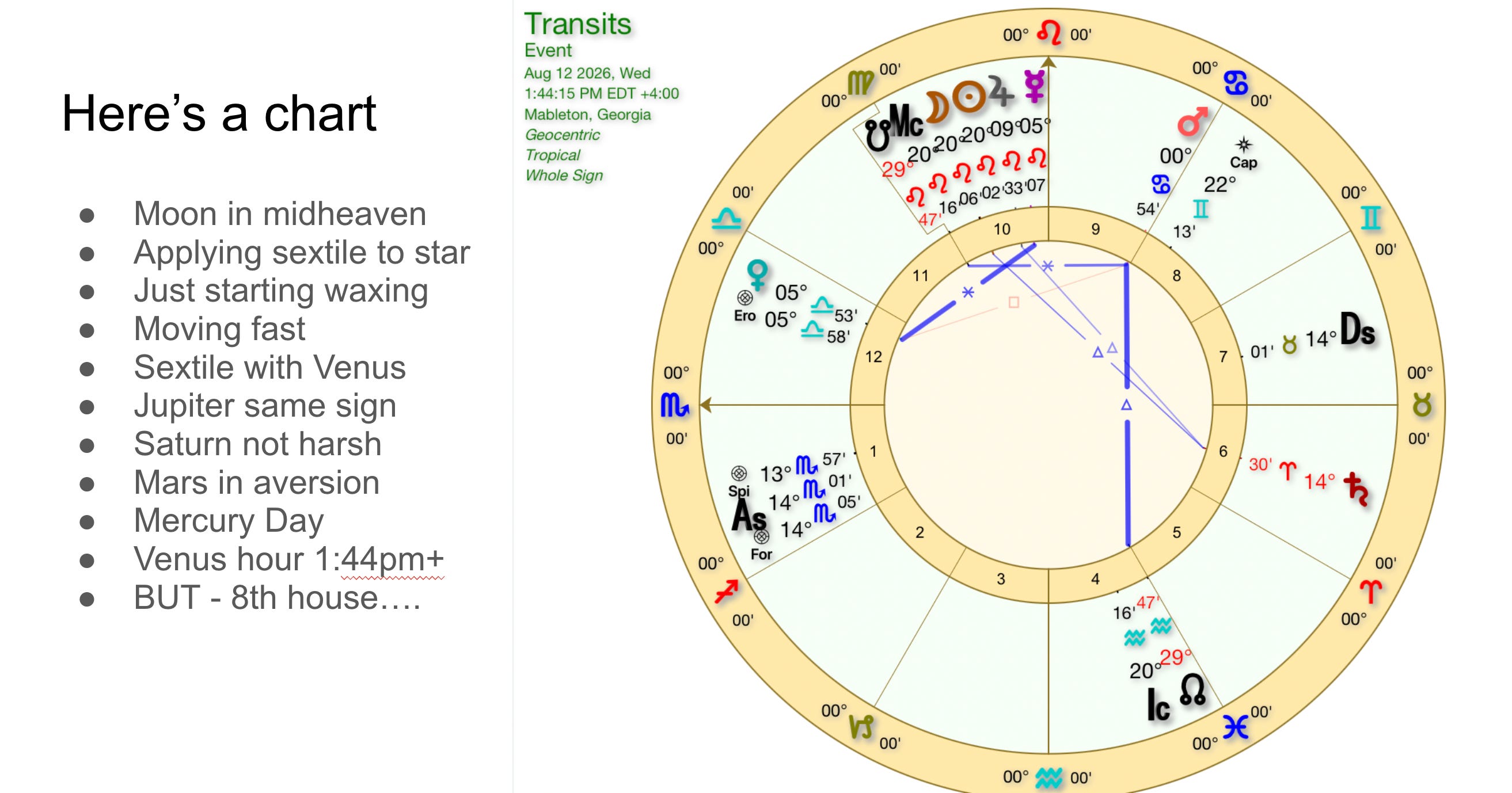
Caption: The election as I presented it - the chart, plus what looked promising and what gave me pause.
(Yes, there’s at least one other major problem with the election - I’ll talk about it in a later entry).
First Pass: Ten Minutes on the Internet
Using only the internet - Astrology King and Wikipedia - here’s the whole first round from about ten minutes of reading and taking notes.
Capella is a Behenian star, so plenty of material is available.
The left shoulder, or the goat, of the Charioteer: the goat that fed Zeus, the shoulder that bears the load.
Other cultures: part of the collar bones in Inuit tradition, the canoe bailer in Hawaii.
Agrippa and Hermes Trismegistus (Agrippa quotes Hermes here, I think), both talk about horehound and sapphire, with an image of a man making merry.
Planetary connection is going to be a problem: Jupiter and Saturn from one source, Mars and Mercury from Ptolemy, Mercury and the Moon from Alvidas. Will need more research.
This is definitely enough for me to work with.
The Tarot Spread
The star seemed interesting enough, and the relationship with my chart seemed interesting enough, that a spread felt like the right next step. This is Amaya Rourke’s The Bridge, a nine-card layout built specifically for opening a relationship with a celestial body, and a great place to start. Divination is always an important tool in workings and a great helper in spirit contact.
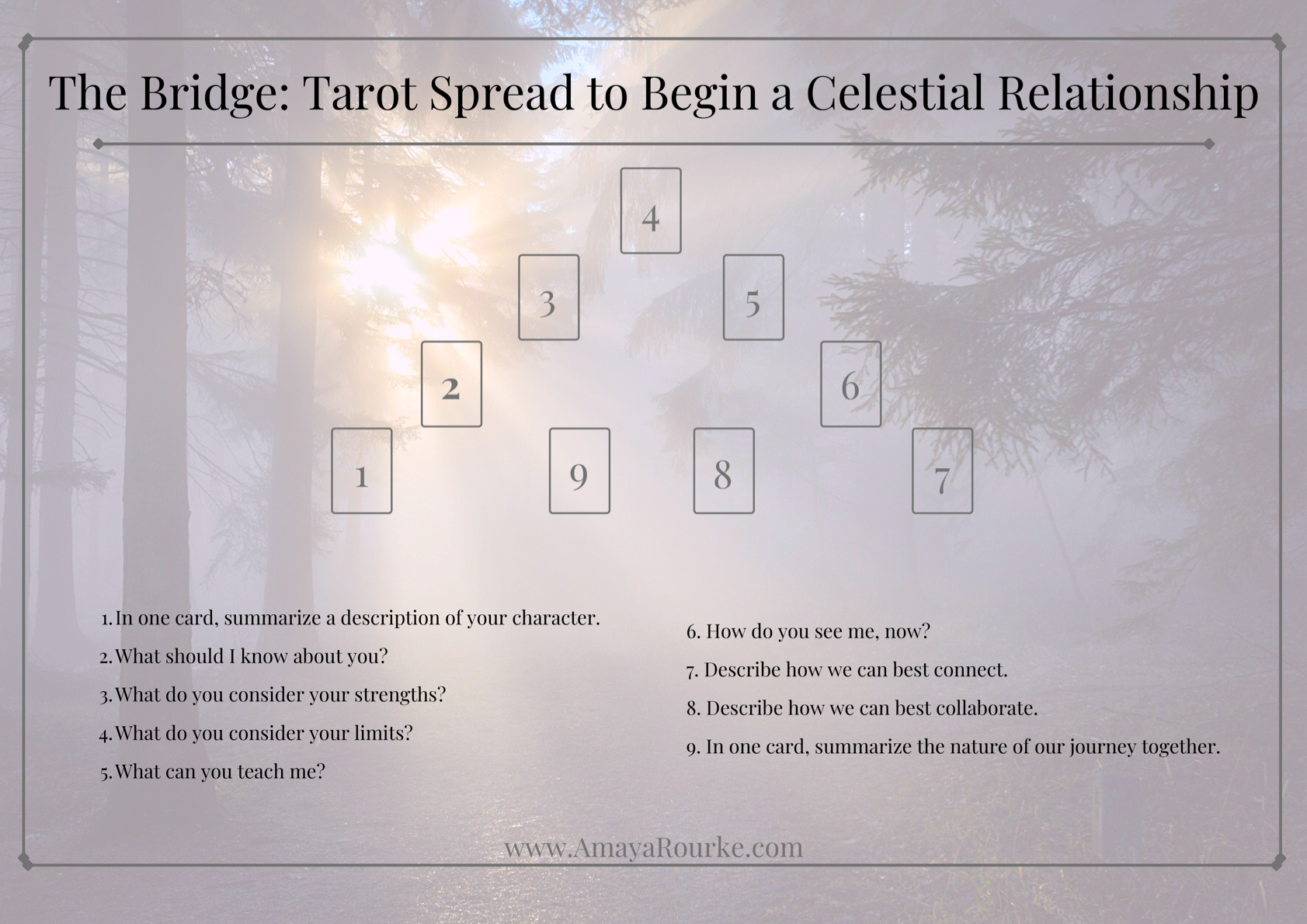
Caption: The spread layout - The Bridge: Tarot Spread to Begin a Celestial Relationship, by Amaya Rourke.
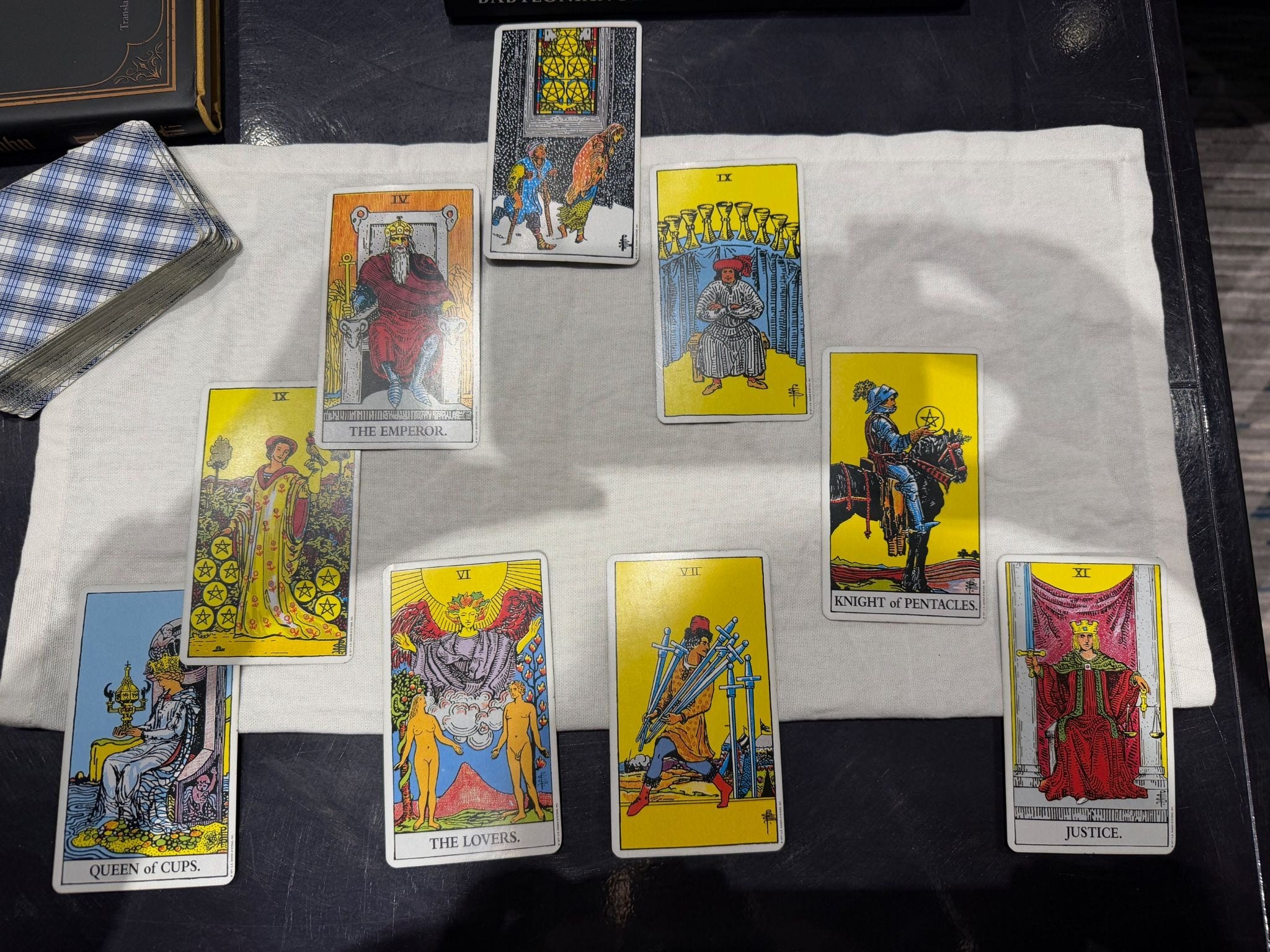
Caption: The actual pull. Quick note: three Major Arcana, no Wands at all.
In one card, summarize a description of your character - Queen of Cups. Matches the nourishing, watery notes I found in my quick research.
What should I know about you - 9 of Pentacles. Someone proud of her accomplishments - another strong feminine note. Interesting later against the Knight: she could be someone who has already done what I need to do.
What do you consider your strengths - The Emperor. Exactly the Zeus story. She can help you reach those heights.
What are your limits - 5 of Pentacles. …but she can’t give you the resources to keep it. That’s a you problem. Note she lost the horn that became the cornucopia - she lacks the bounty herself.
What can you teach me - 9 of Cups. To me this is about finding and enjoying community, which is something I do want to work on. So that’s good.
How do you see me - Knight of Pentacles. Fun - shows me as someone still developing the material skills I need.
How can we best connect - Justice. I’m not sure about this one, and will need to spend time with it.
How can we best collaborate - 7 of Swords. A little odd. I read that card as sneaky, intellectually missing something by choice, or missing out. A partial success. Some ideas, but more consideration needed.
In one card, summarize our journey - The Lovers. That’s about as strong a positive statement as there is.
Interesting, isn’t it? Two of these want more time than one sitting will give them. Justice as the way to connect - I genuinely don’t have a read on immediately, and collaboration as the 7 of Swords is odd enough that I want to sit with it rather than force it into shape.
On The Lovers: I’d consider that an offer of partnership, not of mentorship. She’s not offering to feed me - she’s going to teach me to feed others. Be The Goat, as it were.
This is enough of a positive response that I’m willing to move forward with Capella, cautiously. I consider talisman work to be magician work, or “sword” work, so position eight being a sword tells me talismans may be okay - but the weirdness of that particular sword also says it’s not going to be as satisfying as I’d like, or something else is not right. A learning experience, at minimum. Alkaid has specifically told me no talismans, so here’s a star that’s at least nominally good with it.
Three Majors. There’s some big energy here. She’s a Behenian star, so I’m not surprised. I did spend a moment wondering why I didn’t give The Emperor to her directly, and I think it’s because the first two cards are so strongly feminine. If she wanted me to consider her male, the King of Cups would have tilted it the other way; Queen plus 9 of Pentacles is a strong enough feminine push that it leads me away.
No Wands. This is not a creative, business-empire kind of collaboration. The strong feminine relationship energy - Queen of Cups, 9 of Cups, The Lovers - says to expect a relationship-building experience more than anything else.
Justice and The Emperor. Together these speak to a connection with structure, or government. I’m not sure how that’s going to manifest, but I’ll keep an eye on it. What’s left to work through is Justice as a form of connection - I really, really don’t have time for volunteer work or the justice system, so I’m hoping for something more abstract. And because I have such a worried, anxious feeling about it, I need to let it sit a minute; it’s harder for me to get an honest read when I have Opinions or Preferences about an answer.
Anyway. Sufficiently positive that I’m excited to work with her, and willing to keep exploring the talisman. Time to crack the books.
Book Research
A quick note on method. For each of these sources, this isn’t an exhaustive list of everything it says. I pick out things that feel important, things that match concepts I’ve already read, or things that seem strikingly different. The first time you research a source you may be tempted to write down EVERYTHING. That’s fine - but I’d also recommend a quick read-through of at least one of your major sources, trusting that the important pieces will jump out at you.
Star Lore
Star Lore of All Ages, by William Tyler Olcott, has a chapter on Auriga. Here are the gems I found.
Capella is the heart of the goat.
Very old - from the Euphrates: almost identical to a statue found there, goat included.
Identified with Erichthonius (although so is Boötes).
Capella was associated with Icu of Babylon, and with Marduk.
1600s France - a kneeling Adam, goat climbing over his neck.
Also Phaeton - Helios’ sun, driving the chariot.
Capella as Driver (early in the sky at night, so she watches over the shepherds driving their flocks), or as Singer - riding ahead of the procession cheering on the camels, meaning the Pleiades. Hence Guardian of the Pleiades.
Capella lost a horn to Zeus; it became the cornucopia. Interesting - she LACKS the bounty. See the 5 of Pentacles.
India - Heart of Brahma.
Peru - Colca, the shepherds; culminates in the season when the shepherd manages his flocks.
Egypt, Denderah zodiac - a mummified cat in the hand of a male figure crowned in feathers. Cool imagery, not sure what to do with it. (Olcott is quoting Richard Hinckley Allen’s Star Names and Their Meanings here.)
Temples of Ptah oriented to Capella.
Considered stormy, and bad for sailors - especially her kids (goatlings, other stars in the asterism). There was a festival, Natalis Navigationis, once Capella season had passed, celebrating better weather.
Similar in composition to the Sun, 34 light years away, so the light is “not that old.”
Mentions a Tennyson poem.
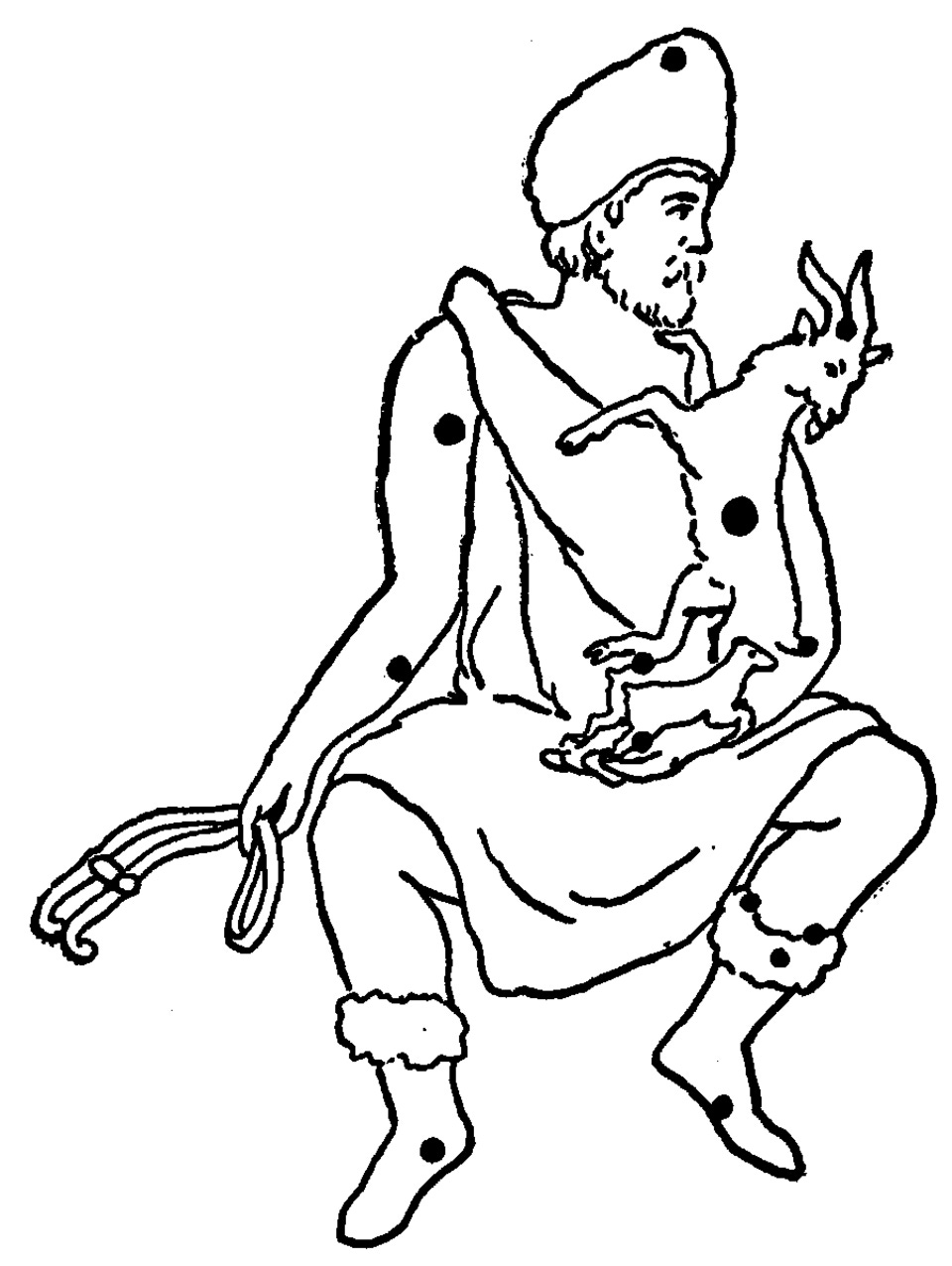
Caption: Auriga with the goat on his shoulder and the kids in his hand - the shape all of this lore is describing, from Star Lore of All Ages (1911).
Olcott brought up a Tennyson poem in connection with Capella, so I tracked it down as a second source in its own right. In the Starry Patrons talk I mentioned using an Orphic Hymn during ritual work, or as an alternative, using a modern poem that addresses the constellation or star directly. This one might count. There are a few lines that reference the Charioteer, but I’m not sold on whether it’s actually suitable for ritual use yet, so I’m filing it for later examination rather than adopting it outright.
…And the shining daffodil dies, and the Charioteer
And starry Gemini hang like glorious crowns
Over Orion’s grave low down in the west…Tennyson, Maud, Part III
A few names came up in the Olcott chapter attached to cultures I don’t have much background in - Hindu, Egyptian, Incan - and Capella or the Charioteer showed up in all three, so I flagged them for a quick follow-up look rather than letting them go by unexamined.
Brahma - creator god, but with no sects that worship him.
Ptah - creator god; god of craftsmen, synced to Hephaestus; a god who listens to prayers.
Colca - qullqa, meaning a storehouse of grain for the Incans.
Honestly, after doing the actual looking, none of these turned out to be as rich as the “further research” label promised - these are just the quick notes from that follow-up pass. Ptah is the one exception that’s still nagging at me, mostly because the Charioteer is sometimes considered the son of Hephaestus, and Ptah is already the Egyptian sync point for Hephaestus. So there’s a small thread connecting all three that might be worth pulling on later.
Fixed Star Astrology
With the mythological digging done, it’s time to check my two best fixed star references for the detailed astrological view: Bernadette Brady’s Book of Fixed Stars and Diana K. Rosenberg’s Secrets of the Ancient Skies, Vol. 1.
Brady
Orientation point for the temple at Eleusis, for Diana as moon god.
The Celts have a strong link between chariots and the feminine nourishing, twins, and so on.
Ebertin: inquisitiveness, curiosity, makes people “odd.”
A nurturing but free-spirited flavor.
In a natal chart, can indicate a need for freedom according to the related planet.
With Mercury: independent thinker, unconventional, able to draw new conclusions from things.
Rosenberg. Similar to Brady, no new/different concepts in there.
Traditional Occult
And now the occulty people - meaning people who actually wrote about magic, historically, rather than modern astrological writers. This is my traditional occult layer: Agrippa, by way of the Three Books of Occult Philosophy, and HT (Hermes Trismegistus, the source underlying the Behenian star correspondences).
Agrippa
The Goat star is in the thirteenth degree of the said Gemini, of the nature of Jupiter, and Saturn… Under the Goat they made an image, the Figure of which was, as it were, a man willing to make himself merry with musical instruments; it maketh him who carrieth it acceptable, honored and exalted before Kings and Princes; and helpeth the pain of the teeth.
Hermes Trismegistus
Alhayhoch - Capella
22 Gemini 11
Stone: sapphire
Main herb: horehound
“Horehound seed mixed with equal parts of mint, wormwood and mandrake, placed etc., exalts men to honors, and brings them the favor of kings and nobles, and heals toothache, and is very medicinal.”

Caption: The sigil, as usually reproduced.
Worth noting on that sigil: in early printings this is a rectangle, not a square, and there are no two “bonus feet” - just an x with dots at the ends. Where did the feet come from?
Herb Correspondences
The four herbs from the HT recipe, plus one bonus.
Horehound (Marrubium vulgare) - Mercury, Air, masculine. Powers in Cunningham’s system: protection and mental clarity. Older folk names like “Seed of Horus” tie it to Egyptian associations, and in medieval Europe it was hung around homes to repel witches’ spells. Its intense bitterness is read symbolically as cutting through illusion or negative influence - the same logic that made it a folk remedy for expelling phlegm gets carried over into expelling unwanted spiritual influence. Used in protection sachets, purification baths, and exorcism or banishing incense.
Mint (Mentha spp.) - Mercury, Air, masculine. Cunningham lists money, lust, healing, travel, protection, and exorcism. The mythic root is Greek: the nymph Minthe was trampled by Demeter out of jealousy over Hades, which is why mint carries an underworld, Hades-and-Persephone thread in some traditions alongside its brighter money and lust associations. Practically - carried in a wallet for prosperity, worn at the wrist for health, placed on the altar to invite helpful spirits, used in travel spells.
Wormwood (Artemisia absinthium) - Mars, Fire, masculine. This one has real depth in the historical record. Culpeper’s 17th-century Complete Herbal placed it under Mars and noted it tends to grow near “martial” iron - foundries - tying its rulership to both the plant’s warming, bitter medicinal action and its energetic profile. Cunningham lists love, protection, psychic powers, and spirit communication, and specifically notes it can be burned with sandalwood in a graveyard to summon the spirits of the dead. It’s sacred to Artemis, its namesake, and folklore ties it to the serpent’s path out of Eden - hence its long use in protective work against bewitchment. Given the toxicity, this is smoke, incense, and amulet work. Not internal use.
Mandrake (Mandragora officinarum) - Saturn, Earth, masculine. Some modern sources reassign it to Mercury or Fire, but the older attribution - consistent with its poisonous, chthonic nature, like most baneful herbs - is Saturn. Cunningham lists love, fertility, protection, money, and health, and associates it with Hecate and Hathor; other sources add Circe, Diana, and Aphrodite. It’s the classic root for poppet work because of its humanoid shape, and the harvesting folklore (screaming when uprooted, a dog used to pull it free) is medieval European in origin. The plant also has a genuine textual pedigree: it appears in Genesis in the Rachel and Leah fertility narrative, which is part of why fertility magic is so central to its correspondences rather than a later invention.
Mugwort (Artemisia vulgaris) - Venus, Earth, feminine. The bonus. Perdue’s Agrippa gives mugwort rather than wormwood, and I’m not sure where the translation issue crept in, so I’m including this as well. Cunningham lists it as sacred to Artemis and Diana; that’s also Culpepper’s placement, who puts mugwort under the dominion of Venus, which lines up with its long medicinal use for “all things female” - childbirth, menstrual complaints, menopause - a use endorsed back to Hippocrates and Dioscorides. Its genus name honors Artemis directly, which is why so many modern sources pull it toward the Moon instead of Venus; Paracelsus is credited with the line asking what Venus is, if not the Artemisia growing in your garden, which is about as clean a statement of the Venus attribution as you’ll find. Powers-wise it does double duty: divination, astral projection, and prophetic dreaming (stuff a pillow with it, or burn it as incense before scrying) alongside strength and protection - hang a bundle at the door to keep evil out. In Chinese medicine it’s the moxa of moxibustion, and the Ainu in Japan burned it in quantity to drive off the spirits of disease.
On the mugwort-versus-wormwood problem: Agrippa (in his latin) used a family-level name, artemisia, which both plants belong to. Possible solution - use both. The herb is called for several times across several stars, and I’d expect mugwort to be the more common intent, but hey. Using them together is fine. I have some of both. Just… don’t eat the wormwood.
The Sapphire Rabbit Hole
Crystal Vaults notes that blue sapphire ranges from pale to deep azure to indigo, the most desired color being the velvety cornflower blue also called Kashmir or bleu de roi. The name comes from Latin sapphirus, Greek sappheiros, and Sanskrit sanipryam, all meaning “blue stone.” And here is where the rabbit hole begins: recent research indicates that what we call lapis lazuli was also referred to as sapphire in the ancient world, and much of the sapphire described in the Bible and other texts would actually have been lapis lazuli.
Today sapphire is still a stone of wisdom - a royal stone of learning, mental acuity, and psychic activation, a seeker after spiritual truth. Its blue ray brings order and healing to the mind, lending strength and focus and an ability to see beneath surface appearances to underlying truths, and to use what it finds there. It stimulates the throat and third eye. Associated with Saturn, it embraces order, structure, and self-discipline, and is ideal for accomplishing goals and manifesting ideas into form.
Since there were two herbs being translated differently, and a source mentioning that sometimes sapphire is actually lapis, I went to archive.org to find a scan of the 1533 first full printing of Agrippa and see what words were actually set in type. Sapphire: there were two different words for the stone by that period, and sapphiru is the one used, rather than anything else. So - probably good? Not great for the budget, but I’m not starting at sapphire for this talisman, so that’s fine.
On the other hand, the real question is what Agrippa’s own source meant - sapphire “true,” or sapphire as lapis lazuli? Lapis is already in my collection, so it might make a good intermediate step before true sapphire. To what extent was Agrippa copying an ancient source versus going off of his own understanding? The books are a large compilation of occult knowledge. This would require more study, but since I’m not looking to do a ‘real talisman’ right now I can stop the rabbit hole digging for now.
Which Planet?
Five sources, five answers.
Ptolemy, Tetrabiblos - Mars and Mercury, for the whole constellation.
Alvidas - Mercury and the Moon.
Liber Hermetis de Stellis Fixis - Jupiter and Saturn.
Noonan - behaves like the Sun.
Agrippa - no planet stated outright, but the herbs he attaches (mint, wormwood, mandrake, horehound) are solar and Mercurial.
A note on Alvidas: a 19th-century pen name, author otherwise unknown. The Liber Hermetis is another of the major works on the Behenian set, the fifteen “magical” stars. Noonan is a modern astrologer, whose book I don’t have, alas, so I’m relying on other people quoting his work instead of direct examination.
To try and untangle this, I want to figure out why each attribution might have been made, rather than picking one and moving on. Brady’s strong emphasis on Capella’s association with freedom is what pushes me toward Mercury - a trans-liminal Hermes, travel-associated, mutable, generally wiggly and fast-moving in character. It also helps that Capella has been sitting in Gemini for a long time now, so it’s been under Mercury’s domain regardless, which will flavor things a little on its own. As for the second planet - Moon, Mars, or something else - I’m not going to worry about pinning that down yet.
Mars is traditionally martial and can indicate plenty of negative things on its own, but I think whatever Mars influence shows up here is a more dignified version of that. Part of the martial signification comes from the fact that the constellation is a charioteer: a warrior shape, yes, but a dignified one. Charioteers have higher status than the average foot soldier, and aren’t an automatic symbol of violence the way a bare sword or a common warrior figure would be. So I’d expect any martial influence here to read as less concerning than a typical Mars attachment.
It’s also worth considering that Capella specifically is part of the goat asterism within the charioteer, and that asterism might bypass the martial attachment of the constellation almost entirely. Goats, on their own, are traditionally Saturnian. But this is specifically the goat who famously nursed and nurtured the infant Zeus, so I’d also consider giving her to the Moon - the Moon carries that feminine, nurturing quality, and feminine horns (like goat horns, or cow horns) are often lunar. Venus could plausibly claim that nurturing thread too, especially toward prosperity. So I’m honestly not certain yet where this lands. I’ll see where it settles as I keep working.
Of course, her relationship to Zeus could also mean she falls under Jupiter. I can see why this varies so much in the texts. I guess I’ll have to ask her myself.
Interlude: Back to the Tarot
Another look at Justice. This could refer to requiring a balance of some sort. Consider her as an equal partner? Do as much for the star as she does for me? Do as much work for others as I do for myself?
I think this is closer. I might do a secondary reading during a contact period - she culminates late morning for me right now. Will devise later.
Good to note: when looking at planet/sign associations, The Emperor is Aries, Justice is Libra, The Lovers is Gemini. The Lovers is also a conversation. This might be a recommendation as well to look at Mars and Venus as the star rulers - and Venus is currently in Libra for this election and trining the star by sign - or Saturn, as he’s in Aries, and opposes Venus by sign. That Venus-Saturn conversation may be part of the work, while the Venus-Mars tarot connection may be part of the general attitude of the star.
Since I’m still not settled on a clean planetary correspondence, I decided to try something a little sneaky: pull up which planet, sign, and decan each of the minor arcana cards I drew is traditionally assigned to, and see whether a pattern falls out that might hint at how to approach her - at least until I have a better sense of what aspect of Capella I’ll actually be working with, and what she personally wants assigned to her. I’m not going to walk through how card-to-decan assignments work here; that’s easily findable elsewhere, and I wouldn’t necessarily recommend this particular method to anyone else. Call it somewhere between an act of desperation and idle curiosity about further connections. (However, to make this comprehensible, please note that a decan is a third of a sign - ten degrees - each with its own planetary ruler.)
Queen of Cups rules Gemini 3 - Cancer 2. Capella is in Gemini 3.
9 of Pentacles is Virgo 2.
5 of Pentacles is Taurus 2.
9 of Cups is Pisces 2.
Knight of Pentacles is Aries 3 - Taurus 2.
So looking at sign and decanic rulership, we have in order: Mercury to Moon by sign; Mercury(sign) and Saturn/Venus(decan); Venus(sign) and Moon/Mercury(decan); Jupiter(sign) and Moon/Jupiter(decan); and Mars to Venus by sign. Taurus 2 is touched twice, and every cup touches a Decan 2 - the fixed, or pivot, point of the space.
Related to the planetary wibblings: lots of Mercury, medium Moon and Venus, a little Saturn, Jupiter, and Mars. The only one who doesn’t show up at all is the Sun - and Noonan says astrologically Capella is like the Sun, so… basically, She Big.
Also, TWO NINES. That penultimate, can’t-get-you-all-the-way-there-but-you-can-see-the-top-from-here energy is interesting.
What’s Next
From the tarot interlude, I think I should also be aware of the general astrological weather for that moment and incorporate a little of it into my creation. Before I finalize the imagery I’ll want to spend a session going thoroughly through the aspects and strength of each planet - what each would signify in that moment, and how it will impact the goal of the talisman as it all comes together. I know I’ll probably be leaning heavier on Mercurial substances.
I’m tentatively planning my first contact with her on Wednesday July 29 (Mercury day), during the afternoon Mercury hour - although the star culminates just before, during a Venus hour, so … we’ll see. Approximate culmination around 2:16pm, Mercury hour starts at 2:55pm. Usually my rituals don’t go that long, so I’ll see how I feel at 2pm and go from there.
The task list from here:
Official Real Contact with Capella. Most important - that’ll give me better direction in general.
Astrological talismanic aspects, wishes, and the rest of the elective detail.
Building the talismanic image and planning the talismanic materials.
Part 2 will pick up with the contact itself. If you’d like it in your inbox, subscribe below.
I read tarot and astrological charts and am available for online readings - I offer a short free consult if you’re not sure what you need. Book a reading here, or find the shop and the rest of my work at planetarycrafts.com.
Sources & Citations
Agrippa, Heinrich Cornelius. Three Books of Occult Philosophy, Book I, Ch. XXXII (Behenian stars) and the Apuleius zodiacal-herb table in the same chapter. Via Peterson’s edition, esotericarchives.com. First full printing, 1533, consulted in scan at archive.org. My favorite translation is Perdue’s Agrippa.
Brady, Bernadette. Brady’s Book of Fixed Stars.
Culpepper, Nicholas. Culpepper’s Complete Herbal. 1653.
Cunningham, Scott. Cunningham’s Encyclopedia of Magical Herbs. Llewellyn, 1985/2000.
Liber Hermetis de Stellis Fixis.
Olcott, William Tyler. Star Lore of All Ages. Chapter on Auriga, including the quote from Richard Hinckley Allen, Star Names and Their Meanings.
Ptolemy. Tetrabiblos.
Rosenberg, Diana K. Secrets of the Ancient Skies, Vol. 1.
Rourke, Amaya. The Bridge: Tarot Spread to Begin a Celestial Relationship. Originally at www.amayarourke.com, but as she’s semi-retired from astrological work it is no longer publically available. Reproduced with permission.
Sapphire descriptions: crystalvaults.com.
Tennyson, Alfred. Maud, Part III.
First-pass online research:
Astrology King (www.astrologyking.com)
Wikipedia (https://en.wikipedia.org/wiki/Capella).